
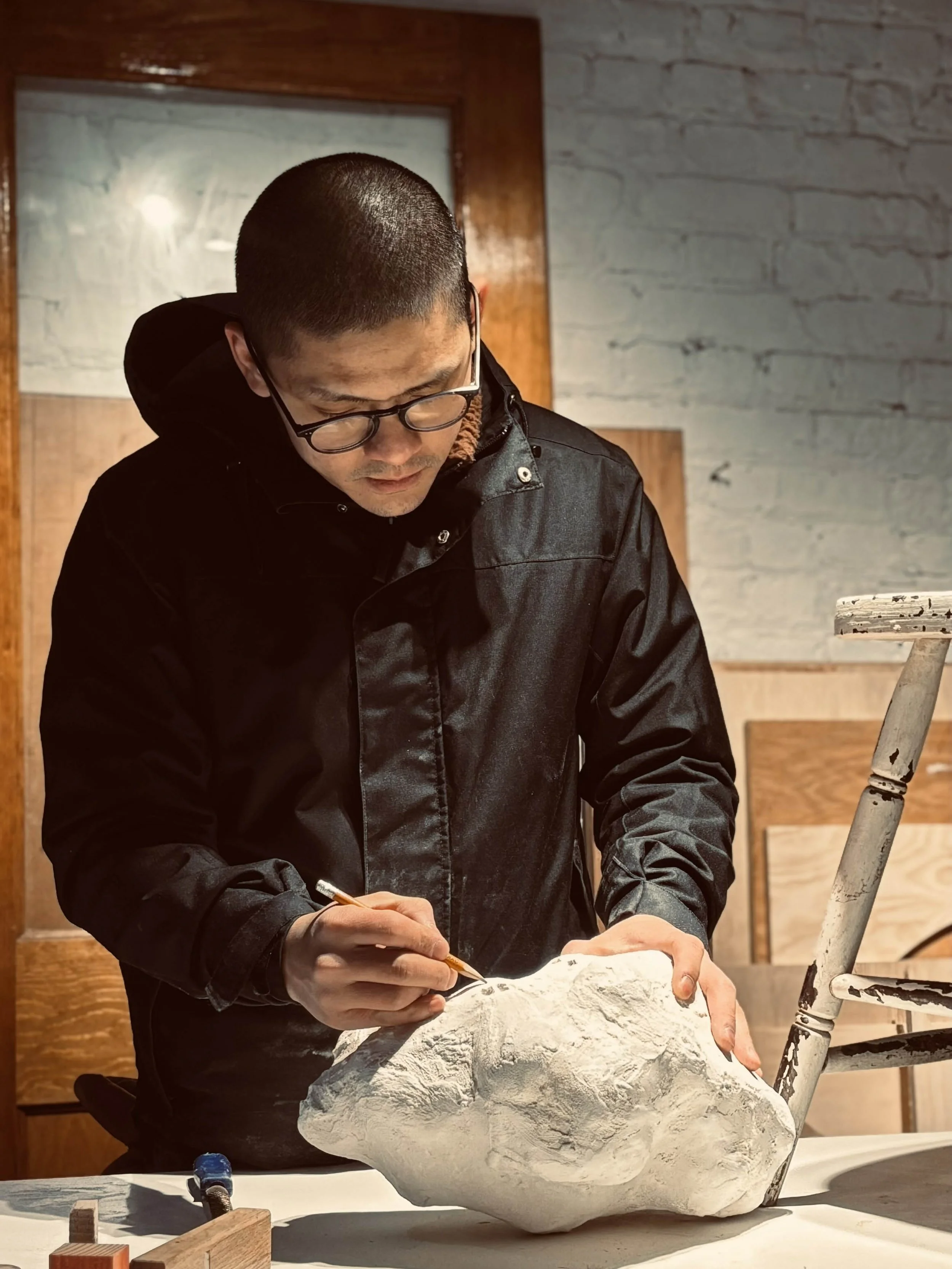
“When you’re navigating the uncertainty of the creative wilderness, you have to keep returning to the basic question: Is there anything that would stop me from wanting to be alive? As long as that answer is no, I keep making work.”
— John Kuo
TV: John, thanks for doing this interview, I’m glad to learn more about your work. I first saw some of your sculptures at the TAAC house on Governors Island, I think that was in 2024, and I’ve seen your work in a few different shows. I loved the sculptures we had in the gallery for your exhibition in March of 2025, all with electric light coming from inside. Some were pretty subtle, which was a really creative and effective device. Have you always been a creative person?
JK: When I was in maybe second grade in elementary school, my mother signed me up for an after school ceramic workshop at the school. I remember that was probably the first time I would interact with clay. The agenda of the class was to make a palm-size bonsai pot (盆景), I remember the teacher’s focus was only for us to make a proper functional bonsai pot, but I was drawn to a bonsai he had brought to show us which had a miniature old man that was holding a fishing rod sitting on the moss, looking like he was fishing from an imaginary pond. For me that was mind-blowing, and it was like a pivotal moment where I realized I could create something that actually exists instead of just a 2-dimensional image. I remember I made a house on the highest part of the pot and I imagined it as a hilltop. And then there were stairs leading down into the pot, which eventually would be filled up with soil and a bonsai tree. Before I knew it I was already immersed in the world I had created. Even until today I still remember vividly how much I was drawn to the world I created and I think that was the moment I first realized what sculpting was like and the power of the ability to create 3-dimensional objects. That was sort of the earliest epiphany of sculpture I had.
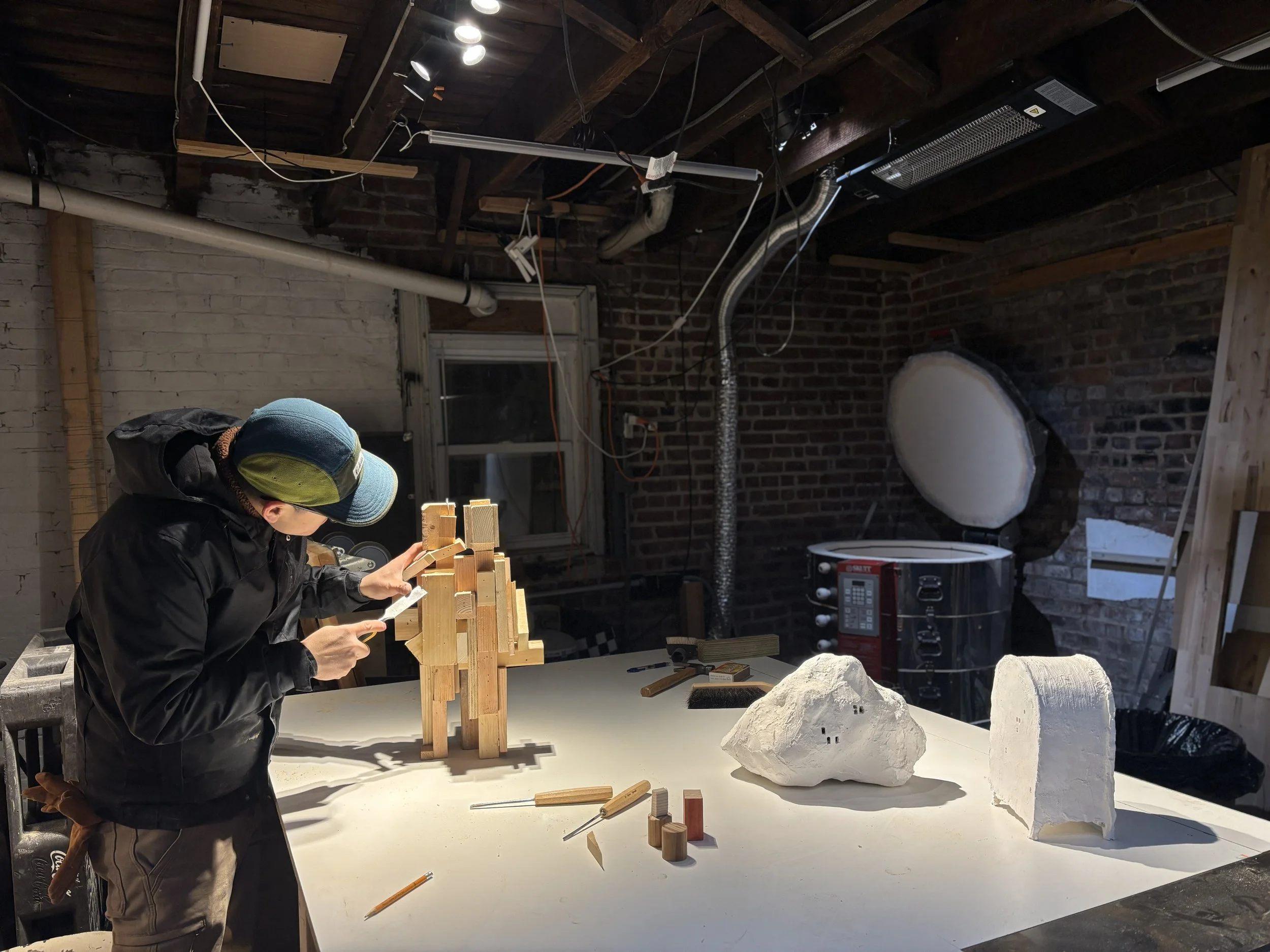
TV: Wow, that is crazy because it sounds a lot like you’re describing one of your more recent sculptures. I’ve seen several of your pieces that incorporate stairs and also works that have allusions to something inside, like the lighting I mentioned earlier. I wonder, who is the first artist you remember being influenced by?
JK: M. C. Escher. I was introduced to M. C. Escher’s work when I had just learned how perspectives works, while I was maybe about 10 or so.
M. C. Escher’s work not only amazed me with his mastermind of hallucinations, but more importantly to me with the architectural worlds he created in his work. I still always gravitate to the infinite cities, villages he creates, sometimes even just casually set in the background of the composition. I found that if you look closely and crop almost any corner of the world he creates in his work, it is always usable for a scene for something to happen just like any corner of the real world. I think that planted this idea of a different realism in my young mind. Another thing that influenced me is how he creates his work in 2-D, but intentionally, at least in most cases, I believe he was always trying to create a believable architectural object or environment. You can say that’s just the underlayment for hallucination, or the fundamental realistic part that supports the surrealism, but I think that to me is maybe a subconscious worship to architecture coming from his background. Interestingly, I grew up in an architect's office. My uncle is an architect, and he used to use our house's first floor as his office. Ever since I can remember, I used to loiter in his office just browsing through his walls full of his collection of architectural books, or being mesmerized by the architectural models. Naturally I became very interested in architecture and wanted to become an architect just like my uncle. But also interestingly, I ended up transferring from architecture school to art school, just like M. C. Escher.
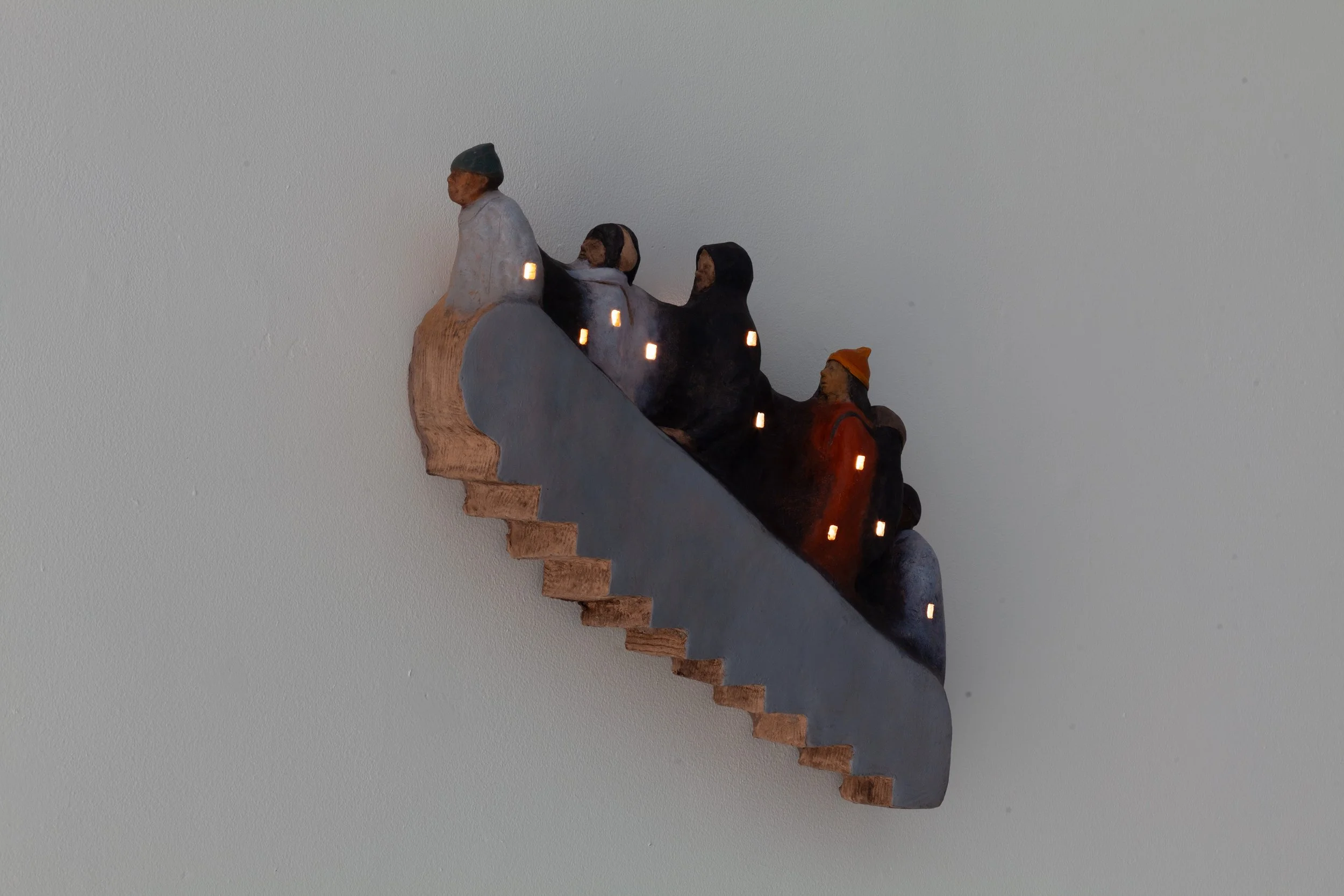
TV: That all makes sense thinking about your work, and of course goes back to the stair elements that you were fascinated with when you were younger. Since there are some abstract elements in your sculptures, I wonder, how do you know when a piece is finished?
JK: I used to paint more than sculpt in my early college time, until I found myself in the ceramics studio again (long after my elementary school ceramic classes).
When I paint, I always have a hard time committing to the last touch of a painting, even if I did commit to the last stroke, the possibility of continuing to work on the piece still troubles me, along with calling a piece “finished”. But with firing the clay, the temperature basically does the last touch. The fact that you only have limited control over the final touch of your work influences me deeply in my practice. I believe in treating the kiln, the studio, and the act of creating art with respect spiritually. For example every time I start a firing, I stand in front of the kiln and put my palms together, eyes closed, then pray to the kiln for the firing to go smoothly, religiously.
Back to the question, to me the process physically finishes while the firing finishes, oftentimes it comes with surprises, good or bad it just seems to be a clear ending in the process, but it doesn’t mean it’s the completion of the work. I believe there’s a bar in an artist’s consciousness and it evolves along with the artist. So to me there’s no universal standard to judge if a work is finished. In other words, I believe the artist should keep working until the bar is reached. So to answer the question, the work's completion comes along with the artist’s contentment.
TV: That is all so profound and makes so much sense to me. I totally understand the desire to continue to add to or change something after the initial intention is completed. Achieving that sense within yourself is much more difficult, but significantly more satisfying. Being an artist really is something only the artist themself can define and live up to. For you, as an artist, do you ever feel like an imposter?
JK: Quite often. Why? I’m not entirely sure. For now, I think it might be the side effect of calling oneself an “artist.” But what exactly is an artist? When you look back through art history searching for an answer, it often makes the imposter syndrome even worse.
I think it’s because the artists who are remembered in history seem impossibly overqualified, almost beyond reach. Does that mean I know a clear set of qualifications for being an artist? I don’t think so.
It’s a bit like language: I may not be able to fully explain the rules of English, but I can speak it. I think this kind of scenario leads to self doubting, but I do believe an artistic career is inevitably bound to encounter this kind of uncertainty, and perhaps learning to live with that is part of the practice itself.
TV: It’s a lot of pressure to measure yourself against those whose achievements you see as significant from the past. Especially when so many of those who we look at in art history didn’t see themselves as we do now. I’m wondering if you follow any of their practices or if you have created your own process and routine. Do you have a studio space where you feel most comfortable in your creative process?
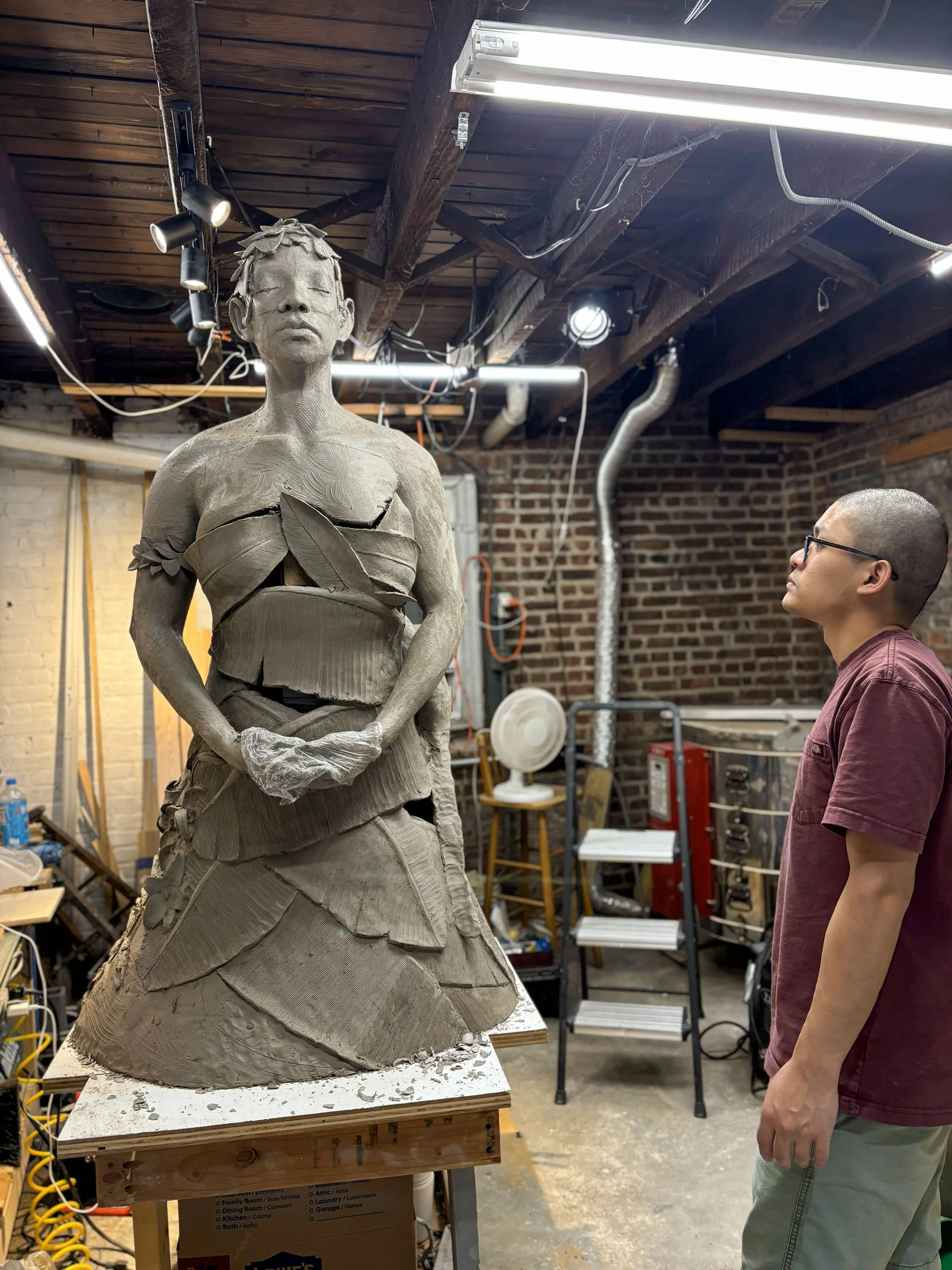
JK: Besides being a sculptor, I also teach at the Art Students League at night. And because of my teaching schedule I get to spend most of my daytime in my studios. Luckily enough I have two work spaces, one is where I do most of my clay work which is in the basement of the house, the other one is sort of a wood-shop in a detached garage space across the backyard. I spend more time in the garage space on the warmer days, and on the winter days I mostly work in the heated basement. The two spaces have two polarized atmospheres. The clay space is a bright environment lit with white lights, which I use when I’m working on colors, details, and accuracy. The wood-shop is lit with warmer spot lights and has more of a barn-like atmosphere with exposed wood joists and brick walls. I have a big white work bench in the wood-shop, I like to call it the “conspiracy board”, like the center piece you’d see when they finally busted the psychopath’s den in a detective movie. I simply use it to conspire ideas and ponder between pieces. I think having two extremely different spaces to do my work helps me a lot for my senses to stay sharp.
TV: These are great images, I love thinking about these 2 different spaces and how they contribute to your work. It’s really amazing that you have created the environments that best suit what you want to do and how you want to spend your time. Is there anything that would stop you from making art?
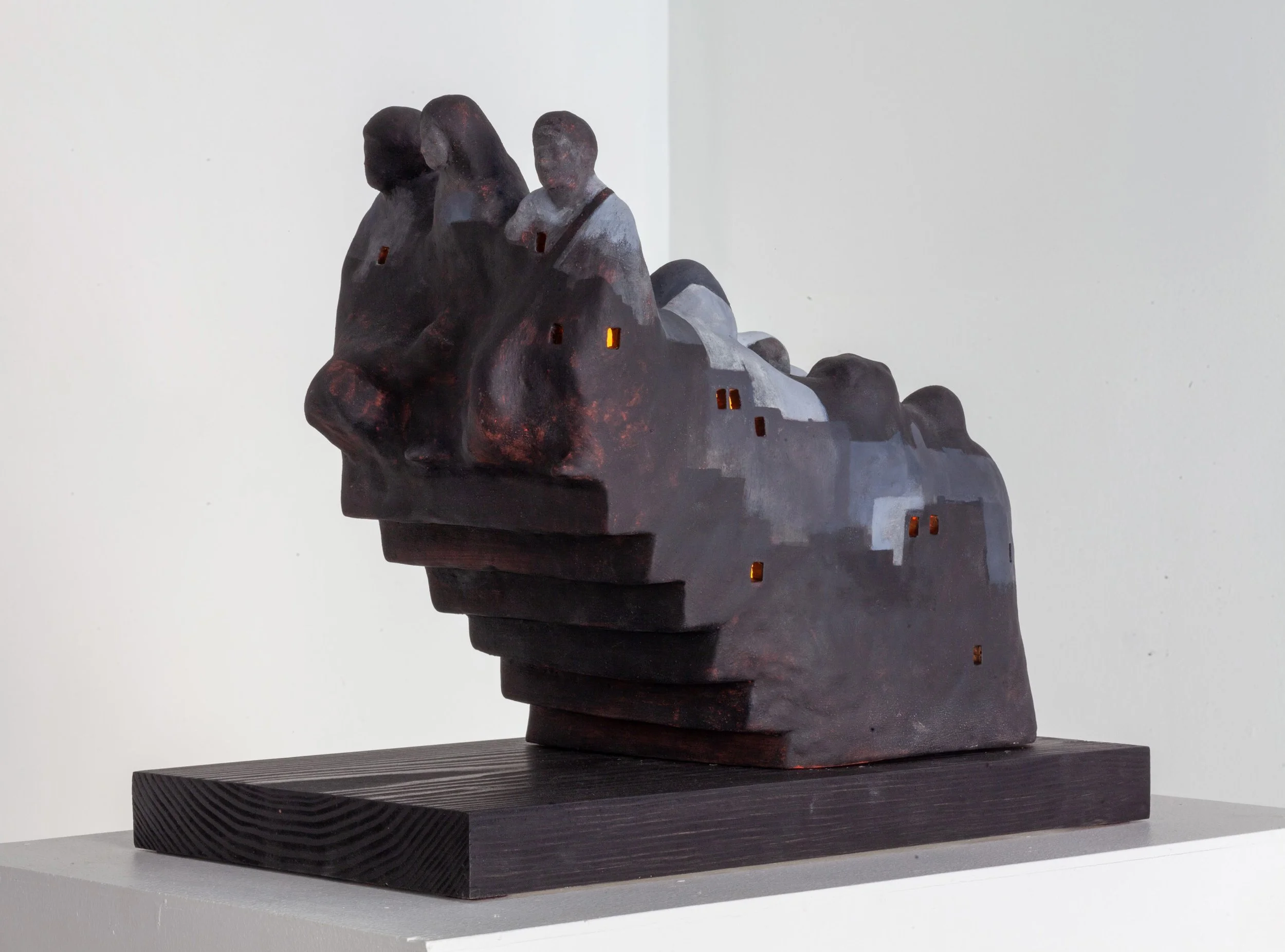
JK: I ask myself this question often, and I don’t think there’s a single, absolute answer. What matters more to me is continuing to ask it. I think for an artist, that question functions as a survival tool. When you’re navigating the uncertainty of the creative wilderness, you have to keep returning to the basic question: Is there anything that would stop me from wanting to be alive? As long as that answer is no, I keep making work.
TV: Well, I’m definitely glad that you’ll keep making work and I’ll look forward to seeing what you work on next. Thanks so much John!
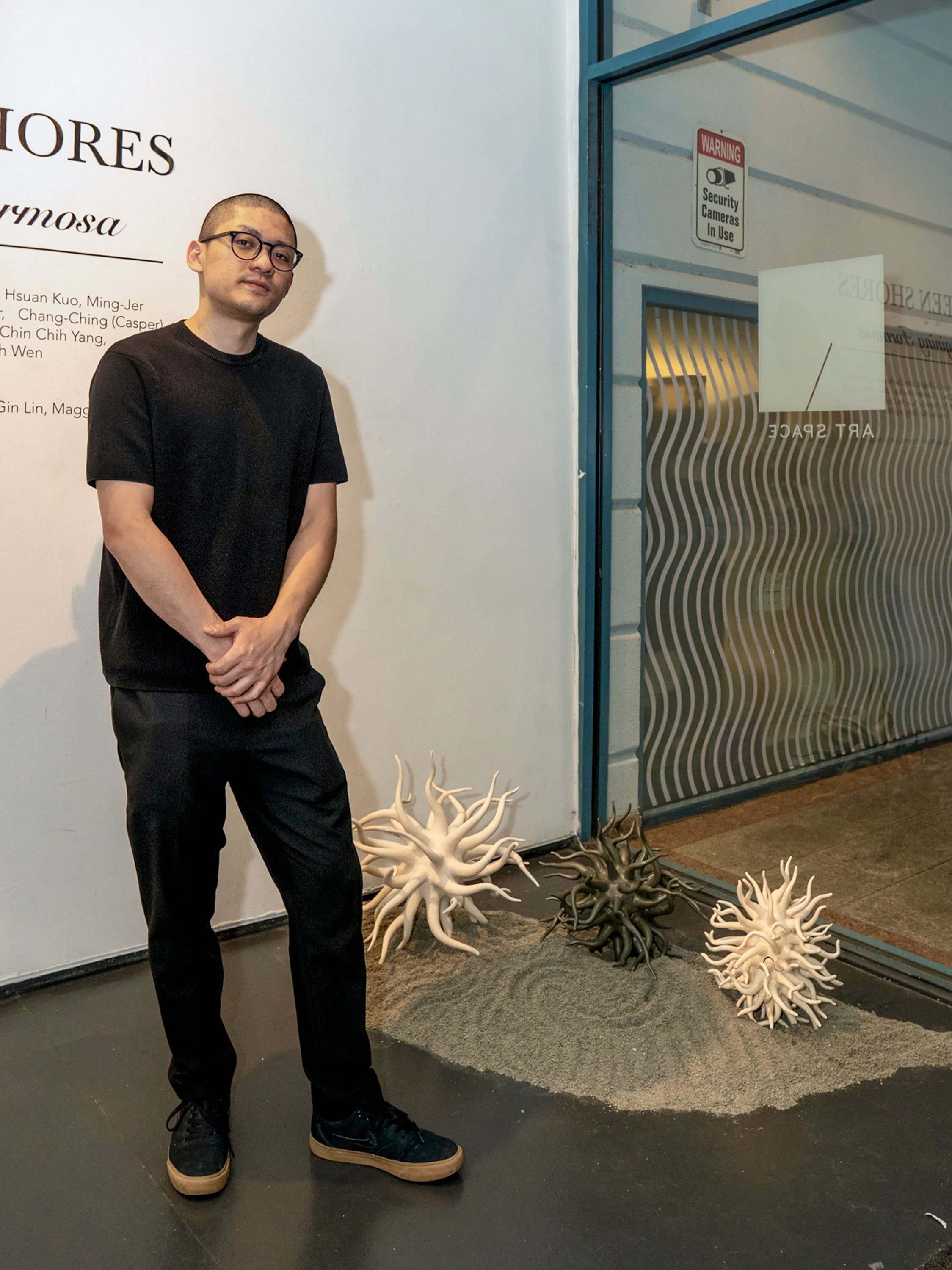
John Kuo lives and works in Jersey City, New Jersey