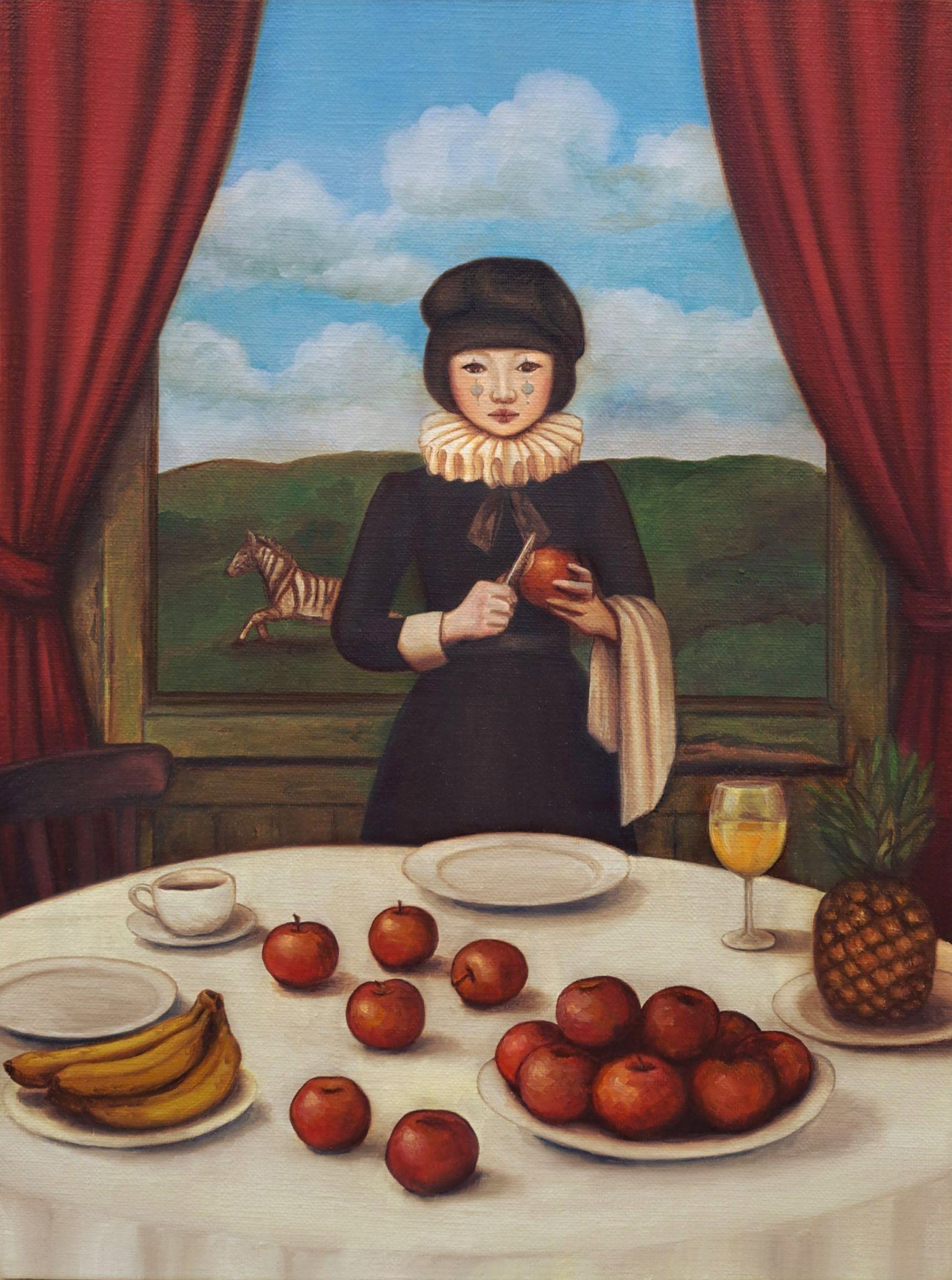
Jaeyi Kim
The Inferior Honor Student
Opening Reception
Saturday, May 9, 3-6 PM
Lei Xiang Gallery, Taipei, Taiwan
On View
Thursday, May 7
through
Saturday, May 23
Gallery Hours
1-7 PM
Tuesday through Saturday
Thomas VanDyke Gallery, New York and Lei Xiang Gallery, Taipei, are pleased to present
The Inferior Honor Student
New paintings by Jaeyi Kim
In her upcoming exhibition The Inferior Honor Student, Jaeyi Kim presents a deeply introspective body of work that expands her evolving visual universe. Her paintings move between memory, identity, and emotional perception, forming a world that feels both personal and widely recognizable.
Kim’s work unfolds through recurring figures that function as both characters and psychological states. At its center is the Pierrot Girl, originally conceived as a self-portrait rooted in the artist’s childhood and long used as a vehicle for self-reflection. Around her exists a shifting cast of women drawn from memory, observation, and imagination.
Rather than seeking resolution, Kim’s practice lingers within layered emotional states. Her figures exist in tension: between innocence and awareness, projection and recognition, interior life and outward presence. Together, they form an interconnected world that feels both imagined and unmistakably real.
The exhibition takes its title from a central painting, The Inferior Honor Student, a work that encapsulates one of Kim’s most persistent concerns: the fracture between outward success and inner self-perception. The paradox embedded in the title speaks to a condition that is both personal and universal, that of the quiet dissonance between how one is seen and how one feels. In Kim’s hands, this tension becomes visual language. Polished surfaces give way to subtle distortions, and symbols of achievement reveal underlying fragility.
Throughout the exhibition, the motif of the apple recurs as a charged and mutable symbol. At times seductive and pristine, at others ruptured or spilling, it reflects the instability of desire, validation, and self-worth. Like much of Kim’s imagery, it resists fixed meaning, instead operating as a shifting anchor within her evolving narrative.
Jaeyi Kim, The Inferior Honor Student
This tension is articulated most directly in the titular work The Inferior Honor Student, where Kim captures the poignant irony of the modern human condition. The title itself serves as a paradox. The “Honor Student” represents the persona we present to the world: perfect, accomplished, and molded by societal expectations. Yet, the modifier 'Inferior' exposes the silent shadow behind the spotlight; the crushing weight of imposter syndrome, the hollowness of external validation, and the secret fear that we are never truly 'enough.'
The apple in the painting serves as a symbol of 'seductive perfection.' Like the shiny skin of the fruit that hides the bruising within, it represents the fragile success that the 'Inferior Honor Student' desperately clings to. It is sweet, yet heavy; a trophy of validation that slowly rots the soul.
Through this work, the artist invites us to confront the gap between our shiny achievements and our crumbling self-worth.
Jaeyi Kim, Wanted Black
In Wanted Black, we see the progression of our hero, the Pierrot Girl, now more self-aware and confident. Her refined but casual outfit demonstrates her growth as an individual. In the Wanted series, the Pierrot girl's eyes are holding both fear and hope; fear that has helped her to grow, and hope that has made her shine. In Wanted Black, she now has a fully-formed body, capable of navigating the world at her will.
Adorned now with the stylish cap of a brave woman rather than the heavy crown that weighed upon her brow with expectations that accompany her given role. She is outside now, no longer confined to her realm, where freedom grows in abundance, collected and shared with the world she is discovering.
The artist’s hope is that the audience will recall their childhood dreams, just as she has.
Jaeyi Kim, Epoch
Epoch gives us a taste of the depth hidden in Kim’s work, ripe with lived reality, carrying references to her own artistic past, as well as to the history that has inspired her.
We see a young woman, comfortable in her surroundings, at ease in a world that she has made her own. Van Gogh’s bedroom serves as an allegory for the artist’s own struggle to be seen and understood, yet it’s what makes this chamber unique that stands out. An apple at her feet, just out of reach and blocked from view by the book she’s lost in. A bear close to the viewer, but hidden from the concentrating girl, signaling that the past is still present, but no longer a concern.
The feeling here may be an “unsettling sensation” or perhaps an “artistic tremor” that one encounters when facing a new world. Whatever it may be, it is a decisive moment: a record of the inner layers, once hidden, finally rising to the surface. Her face is bright, her pose is relaxed, her thoughts are pure. Perhaps she thinks “at that moment, what was necessary to sever with a blade was not an ear, but a single slice of an apple.”
The Spilled Apple again shows us the Pierrot Girl in her new state: fully formed, stylish, ambulatory, carrying herself with pride and confidence, holding the fruit that has given her the self-assured awareness she has sought. No longer dependent on rules or social obligations. Unapologetic, vivacious, powerful, she’s able to claim what she deserves and let go of that which weighs her down. Her veil doesn’t hide her, but frames her. What she carries is her pride. What was poured out was a trophy.
Jaeyi Kim, The Spilled Apple
Jaeyi Kim, Double Layering
In Double Layering, we see a woman, just out of focus, unresolvable, perhaps unknowable. She’s seen in a state of contemplation, her chin resting gently on her hands as she gazes off in thought.
The forms that catch the eye do not remain fixed as a single complete entity; instead, they layer upon one another or scatter into fragments. These unfixed, overlapping, or dispersing shapes emerge when the harmony between body and spirit falters, or when the nerves that sense the world begin to tremble.
These are illusions that emerge only when the mind outpaces the body, or conversely, when physical exhaustion encroaches upon the spirit. This painting transposes those dizzying interstices directly onto the canvas.
Jaeyi Kim, Ambivalence
Miss Carol is another centerpiece of Kim’s recent work. The painting shows us Kim’s gentle adeptness with the human form, and with the emotion that comes attached to it. A gentle and intoxicating woman, reclining in a state of flourishing reverie, her golden-red hair draped over her, like a gently flowing river down the idyllic slope of a distant mountain, her arms aloft, framing her tranquil face.
She is a ceaseless circular dance, a song without beginning or end. Each night her invisible hand guides as circles are traced through worlds yet to be inhabited. Born in the coldest hours, while the world sleeps, and forged in the white heat of inspiration, she is the most intimate secret kept: a silent record that belongs only in the deepest honeycomb of desire.
Jaeyi Kim, Miss Carol
Ambivalence shows us another figure, perhaps the same as Miss Carol, here floating beneath the moon, illuminated by its reflective light, the soft blue glow glancing off her body as she swims effortlessly through space and time.
A continuation of Kim’s Moonlight Haenyeo series, we see her for the first time a woman all on her own, encumbered by costume, unburdened by restraints.
When light and darkness coexist upon the same canvas, the truth that resides between them is finally unmasked. That revelation disclosed itself as the last reason chosen not to release her, but to veil her instead with overlapping layers of hatred and love.
The continuation of another of Kim’s iconic series, Lenormand 4 is another brilliant lesson in how an artist sees her own place in the world she chooses to participate in. Here we see the Pierrot girl in full Napoleonic regalia, as with previous iterations of the series, astride her mount, rearing toward the future.
Her card that was previously dropped is now framed and in the background, as with other motifs, shelved for safekeeping, not occupying consciousness. The rabbit and horse no longer
Fortune Cookie 17 brings a long-running narrative of Kim’s full-circle. Continuing the frame-within-a-frame and painted fabric aesthetic that the series has become known for, but this time showing a grown woman, gentle, unwearied, holding her hand across her breast, not quite provocatively, rather, endearingly, and looking not as though she’s posing, but glancing at you just for a moment, just long enough to register your presence before returning to her own engagements. The fortune on the back of the painting, typed with a Korean typewriter reads “'A happy morning is made by a weary evening” and this tells us everything there is to know about Kim’s work.
What distinguishes Kim’s practice is her ability to render internal states with striking clarity while preserving their ambiguity. Figures appear doubled, blurred, or suspended, as if caught between moments or selves. These visual instabilities mirror emotional ones, depicting states of ambivalence, longing, fear, and quiet resilience that resist simple articulation.
Rather than offering a clarification, The Inferior Honor Student invites viewers into a space of recognition. It is a world where beauty and unease coexist, where personal mythology becomes a shared psychological terrain, and where the act of looking becomes inseparable from the act of self-reflection.
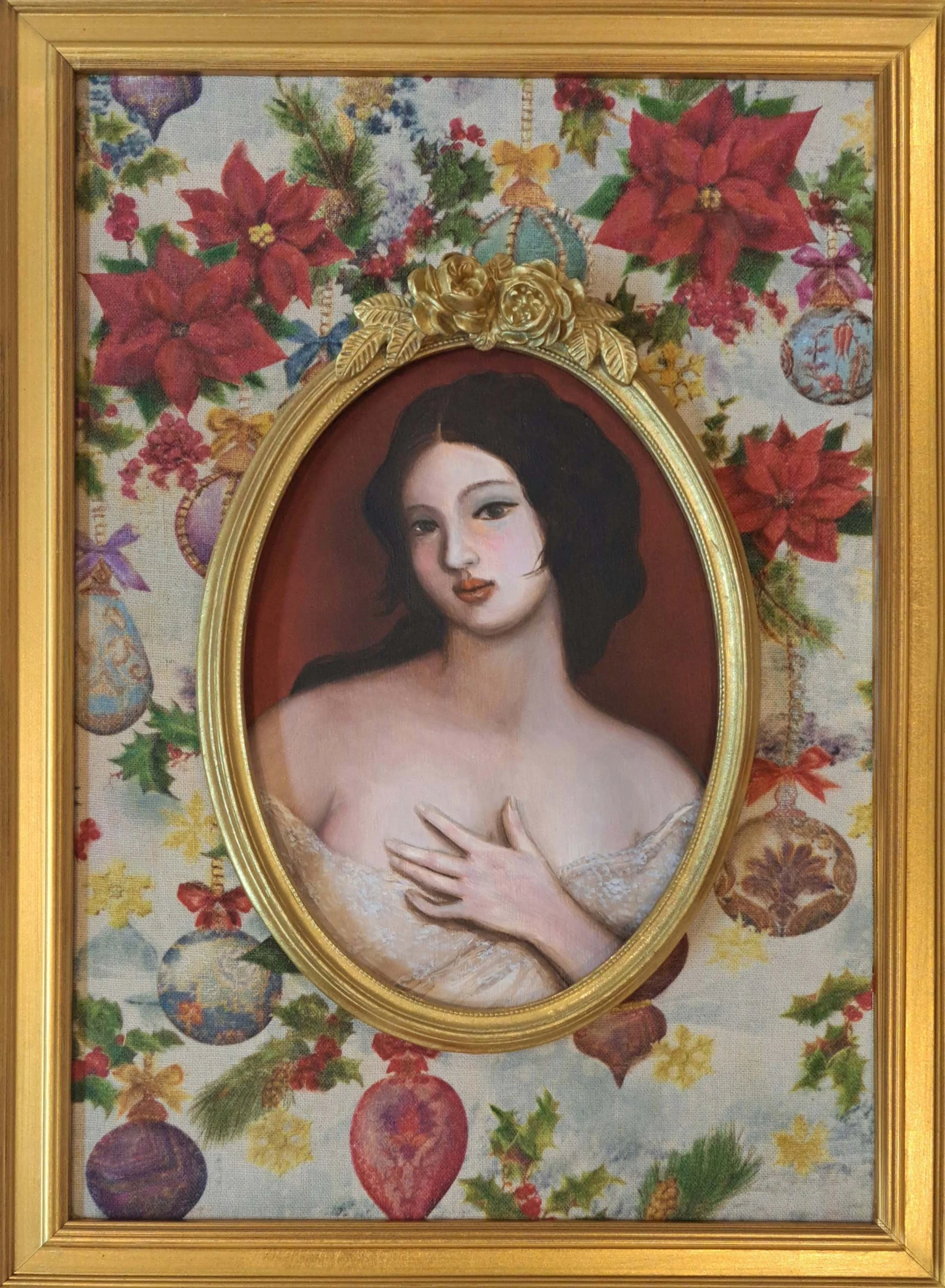
Jaeyi Kim, Fortune Cookie 17
Jaeyi Kim (b. 1972, Seoul, South Korea) is an artist whose work explores identity, memory, and the emotional tension between inner experience and outward perception. Through a recurring visual language of symbolic figures—including the Pierrot Girl and the Haenyeo—Kim constructs a deeply personal yet universally resonant world shaped by introspection, resilience, and quiet transformation.
Her practice is rooted in a commitment to self-understanding rather than external validation. Drawing from childhood memories, personal struggles, and evolving self-awareness, Kim’s paintings reflect a persistent sense of hope in the face of doubt. Blending references to art history with her own symbolic vocabulary, she creates layered narratives that invite viewers into moments of recognition, vulnerability, and emotional clarity.